
 Higher education has been rapidly reshaped by the widespread availability of Large Language Models (LLMs) such as ChatGPT. These artificial intelligence applications are designed for text-processing tasks, trained on vast datasets, and optimised to generate responses based on user prompts. LLMs are capable of adapting to specific writing styles and producing a wide variety of outputs—from simple emails to critical essays and creative works.
Within the School of Communication and Arts, our response to this disruption has required us not only to adapt teaching and assessment practices in disciplines that rely heavily on written communication and visual media, but also to consider the broader implications of AI for our students, their future professions, and the diverse fields represented within the school.
This resource outlines the working party’s suggestions and advice for approaches to AI in the School of Communication and Arts. Here, through a series of case studies of AI use, we raise some of the questions we are asking to think about AI in our discipline, including around ethics, industry applications of AI for our graduates, strategies to integrate AI into useful pedagogical practice, and possible ways to integrate AI into critical and creative practice. [link: https://communication-arts.uq.edu.au/sca-ai-working-party-toolkit]
To address these challenges, the School established the AI Working Party (AIWP) in 2025. This group brings together teachers and researchers across disciplines including public relations, strategic communication, creative and professional writing, digital media, and museum studies. Its purpose is to provide a coordinated response to the opportunities and risks posed by AI. The Working Party aims to act as a bridge between teachers, students, and industry, developing pedagogical strategies that uphold academic integrity while also preparing graduates for the workplace. By fostering adaptability and critical engagement with emerging technologies, the group seeks to equip students with the skills needed to thrive in a rapidly evolving technological landscape.
At UQ’s School of Communication and Arts, we recognise the importance of building strong partnerships between universities and industry. Through our annual events, we bring industry leaders into dialogue with our academics, combining professional expertise with research and teaching strengths to explore AI’s impact on practice, creativity, and culture.
This collaboration allows us to consider not only the practical applications of AI in communication, media, and the arts, but also its broader implications—ethical, social, commercial and creative. It also opens space for exploring AI-inspired creative works, from drama and literature to digital storytelling, ensuring that students and researchers alike engage critically and imaginatively with this rapidly evolving technology.
Through these partnerships, the School is committed to preparing graduates who are equipped with the adaptability, critical insight, and creativity needed to navigate and shape a future in which AI will play a defining role.
AI Industry Forum 2025
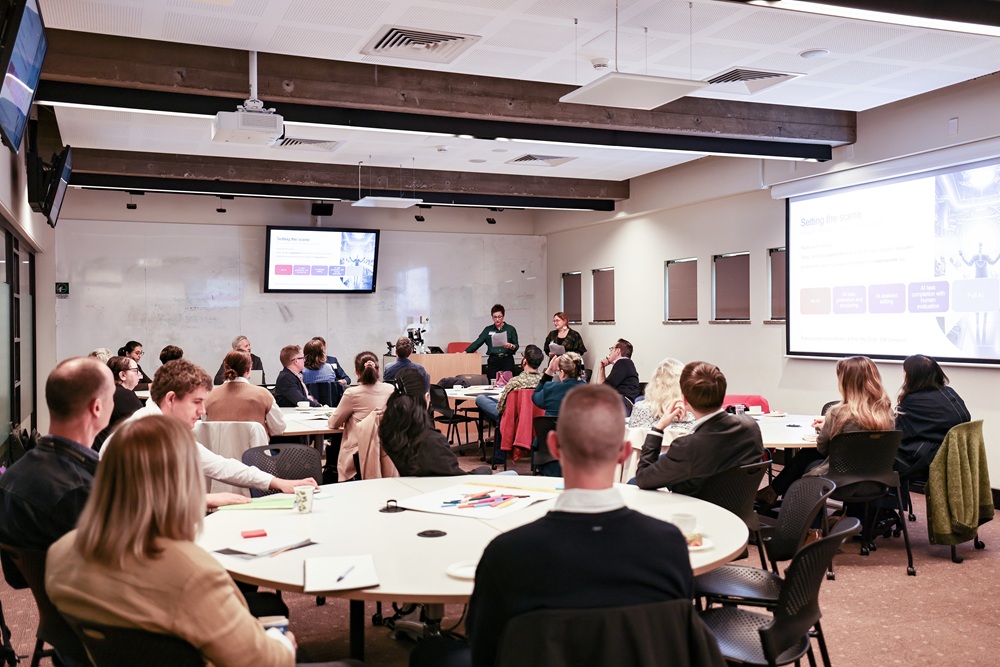
 The 2025 AI Industry forum, held at UQ Central in November, showcased the AI Working Party’s unique strengths: its multidisciplinary composition and commitment to a humanity-centred, rather than discipline specific, approach. Members focussed on futures-thinking, specifically the social and ethical implications of AI, rather than AI tools individually. Attendees reflected this diversity, with representatives from UQ Press, the Qld AI Hub and AI and Society group, through to communication organisations like BBS Communications, Roland, members of the Queensland government and Queensland Curriculum and Assessment Authority, Brisbane Airport Corporation, Brisbane Times and writing creatives in attendance.
A panel of literary, journalism, digital media and creative writing scholars responded to the provocation:
What would the world look like in 10 years if your discipline/sector got to shape the future of AI?
The Forum then shifted into smaller groups. Diverse groups of scholars and industry participants were asked to stretch their imaginations by working to evaluate a scenario, considering judgments and values they wanted to see embedded within. Real scenarios were used as reference points.
The event highlighted the how attendees might seem themselves as directing the AI, rather than the AI directing them. We hope the event will help us not only empower our graduates, but empower the industries they will be working in.
 This resource presents the Working Party’s recommendations for engaging with AI at UQ's School of Communication and Arts. It outlines ethical considerations, provides background on industry expectations regarding graduates’ AI competencies, and offers strategies for integrating AI into both pedagogical practice and creative arts practice.
There is a kind of personification of AI LLM chat bots that works to give the illusion that we are communicating with something that mimics human intelligence. As end users of LLMs, our understanding of intelligence is based on our own embodied ways of moving through the world, processing sensory information into thoughts, ideas, and questions. As Karen Hao (2025) writes, the multimodal properties of LLMs base their sense of “intelligence” on the illusion of being able to “see”, “speak”, “hear”, and “read” (p. 93). But these are computational processes. If you talk to ChatGPT about what your favourite movie is, ChatGPT has not “seen” the movie, but will behave as though it has, based on writing about that movie that exists in its dataset such as reviews or internet commentary. If you talk to ChatGPT about your favourite song, it’s never “heard” the song, but will carry on a conversation with you about it anyway. And, if the song is obscure enough that the lyrics aren’t in its dataset, well, then ChatGPT might just make up completely new lyrics and quote them back to you so that it can act as if it knows what you’re talking about.
Our perception of an LLM’s “intelligence” is entirely based on pre-existing visual and written communication. For those of us in disciplines across communication and arts—literature, art history, film and television, professional and creative writing, digital media, drama, and journalism—that’s kind of our thing. Not only do we work to understand visual and written communication, but we produce it as well. So, if AI’s thing is also our thing: can AI replace us? Should we start to work with it so we can appease it in the off chance it might spare us when it takes over?
The answers are: “a little bit, but not really” and “a little bit, but probably not for that reason”. In that order.
Second thing first. As AI becomes inescapable in everyday life through its integration into online search, information distribution, information manipulation, productivity optimisation, and your digital footprint as training data, it’s something that we, as students, scholars, and practitioners of communication and meaning-making, need to at least understand, if not start to apply with intention. We should think of AI as a tool, just as any other. For now, at least, there needs to be a human in the mix to make it do the thing it’s supposed to do. A hammer can be used to build a house or cause bodily injury (intentionally or accidentally). Likewise, AI can be used with intention by its human operator to help or to harm. Our role is to think about how to imbue our students with approaches that consider the possibilities of what is helpful and harmful about AI. This needs to consider both the end user’s experience as well as the underlying infrastructure of AI, such as its environmental costs for water and energy consumption, and its human costs such as copyright infringement, misinformation, data privacy, and the unseen, often exploitative, labour behind LLM training.
If a human needs to be at the helm, then what do we—as a field in the humanities—consider the role of the human to be? Yes, AI can boost human productivity by generating something in a fraction of a second that might have taken hours for a human to write. But, as Andrea Bubenik (2025) writes, it is process that is the essential human element to all art. In integrating AI as a tool in teaching, learning, and practicing communication and arts, the integration needs to be at the process stage, not a replacement for process that prioritises product. Or, as ChatGPT told us when we asked it what was the essential human element of creativity that it could not replicate, only humans are able to provide context that comes from lived experience and the relational communication of meaning-making to creative ideas. An LLM can create endless ideas: only a human can determine which ones matter, and why.
The case studies presented here outline real-world instances of applied AI use that we have engaged in or observed. They introduce possibilities for how AI can be a process tool in both good and bad practice, raise questions about considering the human elements of that process, and offer suggestions for how an intentional, process-based approach to AI can be integrated into teaching, creative, and critical practice. Whether you’re an AI skeptic or a seasoned user, we hope this gives you something to think about when it comes to AI, communication and arts, and your role in it as a student, teacher, scholar, or practitioner.
Please be assured that despite the preponderance of em dashes in this work, a human wrote it.
Sources:
Bubenik, A. (2025). Why AI will never create real art. Contact. https://stories.uq.edu.au/contact-magazine/why-ai-will-never-create-real-art/index.html
Hao, K. (2025). Empire of AI: Dreams and nightmares in Sam Altman’s OpenAI. Penguin Press.
Henrickson, L., & Zaphir, L. (2025, October 30). What happened to creativity in the classroom? Times Higher Education. https://www.timeshighereducation.com/campus/what-happened-creativity-classroom